AXIOM MARKET SNAPSHOT | NOVEMBER 2026
The Nordic real estate investment market is at its strongest since 2022. According to Savills’ latest Nordics Investment Outlook, regional volumes grew by 26% in January–September, and transaction activity in Finland almost doubled. However, Helsinki’s office vacancy is the highest in the Nordics and calls for new solutions from the industry.
Nordic investment volume Q1–Q3 2026 vs. 2025
Finland’s volume Q1–Q3 2026, almost 2x year on year
Nordic forecast for 2026 (Europe +7%)
Helsinki office vacancy rate
Investment activity has turned to clear growth
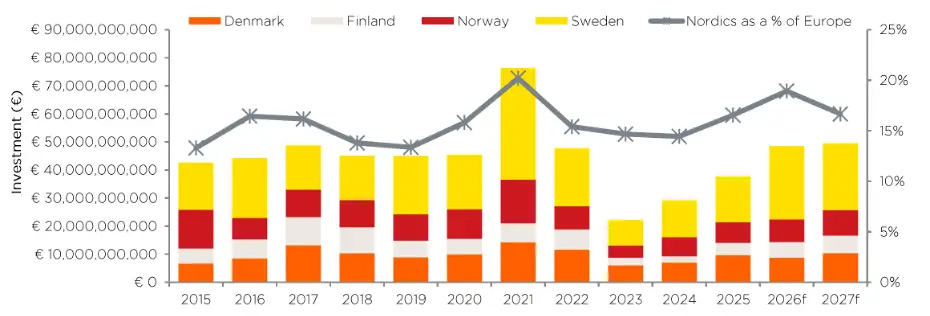
Over the past ten years, the Nordics have accounted for an average of 15% of European real estate investment, around €44bn per year. After the trough of 2023–2024, volumes have grown rapidly: Savills forecasts 20% growth for 2026 and a volume of around €50bn by the end of 2027, 10% above the pre-pandemic average. The Nordics’ share of Europe is forecast to rise to almost 19% in 2026.
The backdrop is positive economic development. GDP is forecast to grow by 2.9% per year in Denmark, 2.1% in Sweden and 1.6% in Finland and Norway in 2026–27, compared with 1.1% in the eurozone. Office-based employment in the region’s major cities is expected to grow by 1.3% per year, more than double the eurozone rate.
Investment volumes by country (€) and Nordics as a share of Europe (%), 2015–2027f
Finland: from behind towards greater weight
Finland’s investment market suffered the most in the Nordics from rising interest rates, and its share of regional volumes fell to an exceptionally low level in 2024. The 2026 recovery has been rapid: January–September volume reached €4.3bn, and according to Savills there is little evidence of distress, thanks in part to a well-functioning lending market.
- Eurozone advantage: Helsinki’s yield spread over other European markets is attracting euro-denominated investors in particular, such as French SCPI funds.
- International capital is returning: Swedish private equity firms and listed companies are active, US capital remains in the market and German institutions are gradually returning. Norwegian capital is also targeting Finland.
- New asset classes: Finland is Europe’s fastest-growing data centre market (25.3% per year in 2024–26), and Helsinki ranks 7th in Savills’ Power & Place Index.
- Challenges: open-ended real estate funds have been net sellers to meet redemptions, and domestic core capital is scarce.
“Savills’ figures match what we are seeing in our own meetings. Investor sentiment has clearly turned over the past year: instead of waiting, we are now discussing concrete investments, timelines and financing. Finland is starting from behind, but its weight in the European investment landscape is rising. A return of domestic capital to the buy side would strengthen the market further. On the other hand, activity is sensitive to interest rate movements. Following the US midterm elections, we hope for more predictable geopolitics and, through that, a stable interest rate environment.”
– Antti Seppälä, Head of Capital Markets, Axiom
Offices: vacancy calls for a smaller office stock
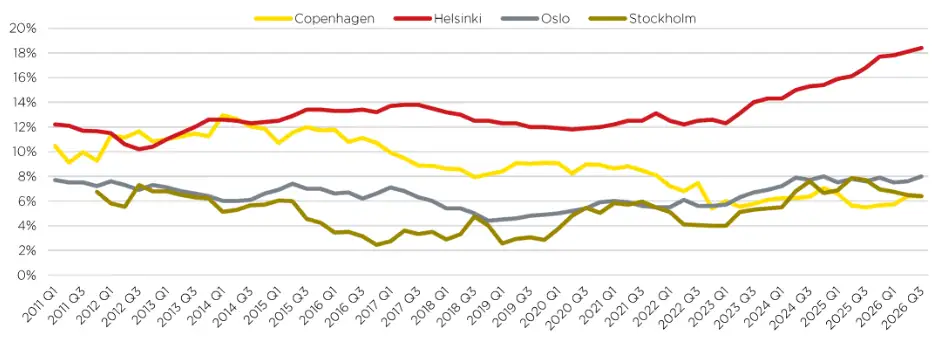
Helsinki’s office vacancy rate has risen from around 12% in early 2023 to over 18%. Meanwhile, vacancy in Stockholm stands at 6.4%, and Copenhagen has one of the lowest rates in Europe. Savills attributes the difference to higher levels of remote working in Finland. Demand is focused on modern, centrally located space: Helsinki’s prime CBD rents have risen by 33% over five years, more than in any other major Nordic city.
Office vacancy rate by city (%), 2011–2026 Q3
“For offices, vacancy remains a significant challenge, and employment growth alone will not solve it. A substantial part of the stock no longer meets occupiers’ needs in terms of location or quality. Industry players should take an open-minded approach to reducing the office stock by converting buildings to other uses, such as residential, hotels, or assisted and student housing. This would also make offices a less risky investment from the perspective of international investors.”
– Antti Seppälä, Head of Capital Markets, Axiom
Further information: Antti Seppälä, Head of Capital Markets, Axiom Advisors Oy,